Agenda item
Questions asked under Standing Order 7(1)(2) and (5).
Minutes:
|
(A) |
Mr Poland asked the following question of the Leader or
his nominee: |
|
|
“Leicestershire County Council has recently carried out a
consultation into school term dates for Leicestershire schools to be in place
between August 2027 and the summer of 2032. Can the Lead Member advise,
if Leicestershire decides to go for an option which is different to the
school term dates of Leicester City, what happens to those schools which are
currently in Leicestershire but may find themselves within the boundary of
Leicester City as a consequence of local government
reorganisation? Would those schools be
required to change their term dates before 2032 in order to
align with the City, or would they remain out of step with City schools until
this matter is next reviewed?” |
|
|
Mr Pugsley replied as follows: |
|
|
“Following the recent consultation on school term dates for Autumn 2027 to Summer 2032, officers have met with colleagues from Leicester City Council to review the feedback received from both consultations. Work is continuing to explore the potential for a shared term date model, informed by consultation responses. The uncertainty surrounding local government reorganisation presents an additional consideration. However, an announcement on the future structure of local government across Leicester, Leicestershire and Rutland is expected in July 2026, ahead of any decision being made on the future pattern of term dates. A summary of the consultation feedback, along with a recommended model, will be reported to Cabinet in September 2026. This will support Cabinet in their decision making for Leicestershire schools and families, taking into account both the ongoing discussions with Leicester City Council and the impact of decisions on local government reorganisation.” |
|
|
Mr Poland asked the
following supplementary question: |
|
|
“I thank the
Leader Member for their reply. I’ve
read the response, but I do remain concerned about the proposal to start
Leicestershire terms earlier beyond the impact of just not matching up with
the City. I would like to ask the Lead
Member to take into account before a decision is made that starting
Leicestershire schools earlier in August would actually risk starting schools
at around the same time as GCSE results are published which would then impact
those in year 11 and going up to post 16, and there would be an impact of
children starting school who may be starting as young as three years
old. August is also one of the hottest
months of the year and we saw only last week the impact severe heat can have
on schools. My own son’s school closed
early because of the heat and summers are only getting hotter so starting
earlier in August would risk
increasing the amount of closures due to heat. My appeal to the Lead Member would
therefore be that, unless there is strong cause for change, unless the
current structure actually is a problem, then I would ask that we keep the
current structure that is broadly in line with Leicester City and is broadly
in line with what we’ve had historically speaking I speak as a parent and as a councillor as
I think the current timetable works well and I wouldn’t want to see any
changes to that which could end up causing more problems.” |
|
|
Mr Pugsley replies
as follows: |
|
|
“I’d like to thank
Mr Poland for his comments and I will ensure that
they are considered before a decision is made. Thank you.” |
|
(B) |
Mrs Taylor asked the following question of the Leader
or his nominee: |
|
|
“1. Can the administration provide the current
backlog of pothole repairs across Leicestershire, and how this has changed
over the past 12 months? 2. What is the average repair time for
potholes, and is this meeting the Council’s own targets? 3. Why do residents continue to report
repeated pothole failures on the same roads? 4. What proportion of repairs are temporary
rather than permanent? 5. How much is being spent on reactive repairs compared with long-term resurfacing?” |
|
|
Mr Hamilton-Gray replied as follows: |
|
|
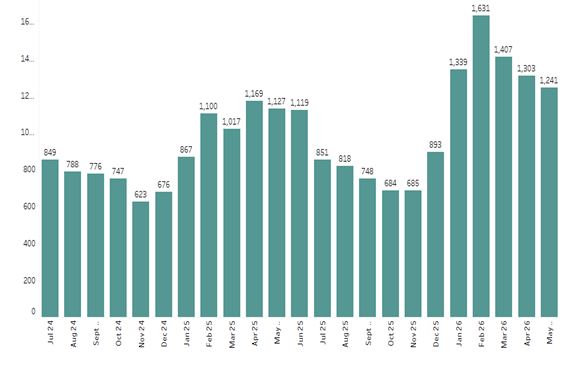
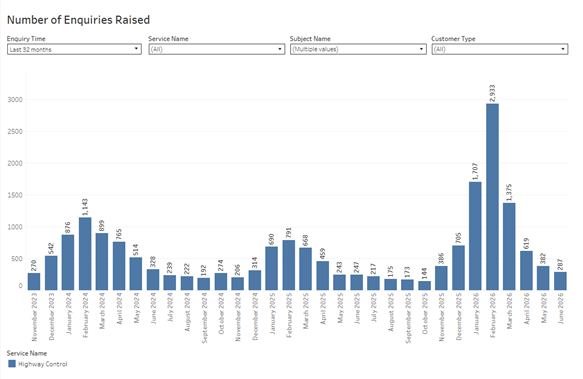
“1. As of 9 June 2026, there are 910 outstanding pothole repair jobs. The number of outstanding jobs at the end of each month is shown on the graph below:
Number of enquiries raised in the last 32 months:
2. The
average time taken to fill a Category 1 pothole (over 40mm deep) in 2025/26
is 2.51 days. The target is 3 days. 3. Under investment, the funding that has
been available for highway maintenance in real terms has declined over the
last decade. This inability to invest as needed has led to the road network
deteriorating which has led to more defect repair work being required. Due to
the limited funding, repairs need to be prioritised hence at times we will
repair parts of a road but not other less severe
defects in that same road. In short,
we have insufficient funding to resurface the whole road. 4. In 2025/26: 23.67% of pothole repairs were temporary (winter 2025/26 was particularly challenging; in previous years less than 5% of repairs have been temporary), The “default” is to use hot quarried material in Roadmenders for permanent reactive repairs – temporary repairs are only carried out for anything that needs to be made safe quickly (e.g. while we wait for a permit, road-space, traffic management or the road is going to be resurfaced), out of hours or emergency responses, or if demand peaks like it did over winter 2025/26. 5. Budgets for this financial year 2026/27: a) Reactive repairs: · £3,355,313 Roadmender repairs b) Proactive carriageway repairs: · £1,900,000 (inhouse) patching gangs · £9, 081,571 (external) machine lay patching · £6,957,931 Surface Dressing (including pre-patching) · £200,000 joint sealing · £495,275 micro asphalt and asphalt preservation · £4,783,519 Carriageway resurfacing schemes Total: £23,418,296 |
|
|
Mrs Taylor asked
the following supplementary question: |
|
|
“I thank the Lead
Member for their response. The
response does provide a snapshot of the current performance but does not
really tell us whether things have improved or worsened under the current
administration. Can the Lead Member
please state what the backlog of outstanding pothole repairs are, the average
repair time and what the proportion of temporary repairs were in May 2025
when Reform took control, and confirm whether these measures are now better
or worse?” |
|
|
Mr Hamilton Gray
replied as follows: |
|
|
“I thank Mrs
Taylor for her additional
question. What I can say is this is
the highest number of defect inquiries we’ve had so far to date in recorded
history. Quarter 1 alone this year
we’ve had 6,150, with 2,933 reports in February alone for potholes. That’s versus 2,149 the year before. It’s a huge strain on our already limited
resources. We have reasons for that;
very wet weather combined with a freeze/thaw action on the roads which has
resulted in potholes developing. But
ultimately, this comes from 10 to 15 years of underinvestment in our roads,
and we are now paying the price for that unfortunately. Traffic levels also continue to rise and
there is an increase in the number of HGVs. We have invested
£2.5m since this administration came to power to repair our roads, and we
have repair over 10,000 potholes per year.
So, we are making our road better for our residents. It is a huge priority for us and its one
that we are going to tackle head on.” |
|
(C) |
Mrs Taylor asked the following question of the Leader
or his nominee:
|
|
|
“1. What measurable improvements in public
health outcomes have been delivered over the past year? 2. How is the Council addressing inequalities in health outcomes across Leicestershire? 3. What proportion of the public health
budget is allocated to prevention compared with crisis intervention?” |
|
|
Mr Paul Harrison replied as follows: |
|
|
“1. The latest version of the national Public
Health Outcomes Framework (PHOF) was published in May of this year. This lists the most up to data for a wide
range of public health indicators. For
Leicestershire, this shows improvement in performance since the last
published PHOF in: • Children in absolute low income families • The rate of complaints about noise • Breastfeeding prevalence at 6-8 weeks • Smoking status at time of delivery • Proportion of the population meeting the recommended ‘5 a day’ on a ‘usual day’ • Cervical cancer screening coverage (aged 25 to 49 years) • Bowel cancer screening coverage • Cumulative percentage of the eligible population aged 40 to 74 who received an NHS health check • New sexually transmitted infection diagnoses • HPV vaccination coverage for two doses (13 to 14 years old), males and females • Meningococcal ACWY conjugate vaccine coverage (14 to 15 years) Across the 149 indicators in the PHOF for which comparative data is available, Leicestershire is significantly better than the England average in 72 indicators, significantly worse in 20 and comparable to the England average in 57 indicators 2. The
Council applies the principle of proportionate universalism to its work on
inequalities: services are available to all residents, while more intensive
or tailored support is directed to those with the greatest need. The Council delivers targeted, evidence-based prevention and health improvement programmes. These include work on healthy weight, food and nutrition, oral health, Making Every Contact Count, suicide prevention, Healthy Leicestershire communications, harmful gambling, sexual health and substance use. These programmes are informed by evidence, local intelligence and community insight, so that activity is targeted towards priority populations and neighbourhoods where it can have the greatest impact. Public communications are also designed to improve health literacy, increase awareness of support and improve uptake among groups that may otherwise be less likely to access services. For example, our Quit Ready stop smoking service is open to the wider population but includes targeted support for groups at higher risk of smoking or who may face greater barriers to quitting, such as routine and manual workers and pregnant women. Reducing health inequalities cannot be achieved by one organisation acting alone. We therefore work closely with NHS partners, district councils and voluntary and community sector organisations to align activity, reduce fragmentation and ensure programmes are shaped by lived experience. Through our statutory role in providing public health advice to the Integrated Care Board, we also support wider system action to address inequalities in access, experience and outcomes. Overall, the Council’s approach is to act both upstream and locally: preventing avoidable ill health, targeting support where need is greatest, working with partners and communities to reduce gaps in outcomes across Leicestershire. 3.
The
whole of the public health budget is spent accordance with the Department of
Health’s conditions attached to the public health grant. None of the grant is spent on ‘crisis
resolution’. Broadly there are three
main levels of prevention: • Primary
prevention, where the objective is to prevent problems arising in the first
place • Secondary
prevention, where the aim is to identify those at risk and intervene to
enable people to remain in good health as long as possible • Tertiary
prevention, where the aim is to reduce the impact of an ongoing issue,
focussing on helping individuals manage and improve their quality of life Within public health around two thirds is spent on ‘treatment services’
in the secondary and tertiary prevention levels (for instance treating
sexually transmitted infections where the aim would be to prevent infection
being passed on to others), a quarter is spent on primary prevention and the
remainder is spent on community based initiatives where the aim is to build
community resilience to enable communities to support each other and build
their own capacity, which can be considered as a pre-primary prevention level
intervention.” |
|
|
Mrs Taylor asked the following
supplementary question: |
|
|
“I thank the Lead Member for their response. The answer describes a range of programmes and initiatives but can the Lead Member point to any specific examples where a Council intervention had demonstratively reduced a health inequality, rather than simply delivered activity or awareness campaigns?” |
|
|
Mr Paul Harrison replied as follows: |
|
|
The Lead member undertook to provide a written response after the meeting. |
|
(D) |
Mrs Taylor asked the following question of the Leader
or his nominee: |
|
|
“I was disappointed to learn that since May 2025, this
Council has withdrawn its commitment to the Elected Members East Midlands
Prevent Group—an initiative I helped establish in partnership with other East
Midlands councils, the Home Office, and Counter Terrorism Policing to
strengthen community safety. Given that keeping residents safe is a core priority of this Council, can the Lead Member explain why this commitment has lapsed, and will they now commit to rejoining and actively participating in this important regional partnership?” |
|
|
Mr Abbott replied as follows: |
|
|
“During 2025 the
East Midlands Elected Members Prevent Group was Chaired by the Lead Member
for Safer Communities from Nottinghamshire County Council and Co-Chaired by
Leicestershire County Council. The
meetings were managed and led by the Home Office. Following the May
2025 local elections both elected members stood down, and the meeting was put
on hold by the Home Office. Leicestershire
County Council has discussed re-convening the meeting with the Home Office
who have confirmed that resurrecting this meeting is not a current priority
for them. The Home Office
went on to say that they are reassured by the annual benchmarking conversation with East
Midlands local authorities that Prevent leads are regularly briefing their
lead members, therefore, for the time being the Home Office do not have any
plans to reinstate this meeting. In my capacity as
the Portfolio Lead for Communities and Community Safety I assure Mrs Taylor
that should the Home Office reinstate this meeting I will be happy to support
it.” |
|
|
Mrs Taylor asked
the following supplementary question: |
|
|
“I welcome the confirmation
that the Council would support the group if it was reinstated. However, given that Leicestershire
previously co-chaired this regional forum, does the Lead Member agree that
counter-extremism and community cohesion remain important priorities for
elected members? If so, rather than
simply waiting for the Home Office to act, will he work proactively with
neighbouring authorities to re-establish a mechanism for member engagement,
scrutiny and collaboration on Prevent across the East Midlands, and what
alternative arrangements has this administration put in pace since May 2025
to provide that level of oversight in the meantime? |
|
|
Mr Abbot replied as
follows: |
|
|
The Lead Member
undertook to provide a written response after the meeting. |
|
(E) |
Mrs Page asked the following question of the Leader or
his nominee: |
|
|
“Our Leicestershire roundabouts used to be fine features to enhance and promoting the realm, pride of place and indeed generating some income to the County Council. Roundabouts are now looking untidy and poorly maintained. Whilst I appreciate the County Council changed contractor and there may have been a time delay, I ask the following questions:
|
|
|
Mr Hamilton-Gray replied as follows: |
|
|
“1. The ESPO contract for the maintenance of roundabouts was renewed on 1st December 2024 to comply with contractual procedure and was awarded to CP Media, now trading as Outdo Media. The previous contractor Keegan Ford ceased operating. 2. There is a schedule of maintenance which specifies two visits per month to each roundabout to include grass cutting, shrub maintenance and pruning, inspecting trees, applying weed treatment, cleaning signs and litter picking – all as required. 3. A full Leicestershire program has been in place from the commencement of the contract. 4. There
is no intention to publish on the County Council website. 5. The Frank Whittle Roundabout is scheduled a visit on 15th June and will be visited twice monthly.” |
|
|
Mrs Page asked the following
supplementary question: |
|
|
“I thank the Lead Member for his replies. My supplementary to the reply given to question number 2 is that, if the roundabout maintenance takes place twice monthly, why did the grass and the vegetation grow out of all proportions for me to find it necessary to bring this question forward after 20 years of no complaints and why has the vegetation in the middle of the Whittle Roundabout still not been attended to? Regarding the reply to question 3, and noting there must be legitimate reason for not publishing details on the website, but in order to scrutinise and check that the works have been carried out in line with our contract procedures would you agree that it would be prudent for every County Councillor to know when the roundabout maintenance is due in their division?” |
|
|
Mr
Hamilton-Gray replied as follows: |
|
|
“I thank Mrs Page for her questions. I will get back to you with a written response to your first supplementary question. Regarding your second question, we do not publish fixed maintenance dates, as schedules need to remain flexible for operational reasons and can change throughout the growing season. We will, however, discuss further with the contractor to establish if we are able to provide local members with information for their areas. I’d find this helpful as well so thank you for bringing that to the Chamber.”
|
|
(F) |
Mr Charlesworth asked the following question of the
Leader or his nominee: |
|
|
“In the UK, the level of antisemitism is at its highest level since the height of the war in Gaza. There was some time ago a series of incidents at County Hall that all members were alerted to. Have there been any more incidents and does the council have a robust plan to deter and deal with any such incidents?” |
|
|
Mr Dan Harrison replied as follows: |
|
|
“The Council takes all forms of hate-related behaviour, including antisemitism, extremely seriously. We have a clear and consistent position of zero tolerance towards such conduct, whether it occurs within our workplaces or in the communities we serve. In terms of recent incidents, there have been no repeat incidents of the kind previously reported at County Hall. It would not be appropriate to comment on specific matters, particularly where these may involve internal processes or individuals. Where any concerns of this nature are raised, they are dealt with promptly and in accordance with our established policies and procedures. It would not be appropriate to comment on individual cases or internal processes More broadly, the Council has in place a range of measures to help prevent and respond to hate-related incidents. These include promoting awareness and respectful behaviour, supporting staff and members, and ensuring that appropriate reporting and response mechanisms are available. We also keep our arrangements under review, including security and safeguarding measures where necessary, to ensure that they remain effective and proportionate. Through this approach, the Council seeks both to deter such behaviour and to respond appropriately where concerns are raised.” |
|
(G) |
Mr Orson asked the following question of the Leader or
his nominee: |
|
|
“Regarding the
£50,000 announced for the fast response grass cutting crew, can the Lead
Member please tell me:
|
|
|
Mr Hamilton-Gray replied as follows: |
|
|
“Please note that the MTFS amendments included £80,000 (rather than £50,000) for two years for the additional “reactive” grass cutting crew. 1.
Funding for the additional grass cutting crew
has initially been secured for two years. 2.
During the grass cutting season (April –
September), an additional crew of two operatives with vehicle, trailer and
ride on mower will have access to additional equipment like a strimmer and
hedge cutter etc to respond to priority reports of grass or vegetation
blocking visibility or causing a safety concern. 3. The work completed by the additional gang will be recorded in the Council’s Highway Management System.” |
|
|
Mr Orson asked the
following supplementary question: |
|
|
“Thank you Mr Hamilton-Gray for the replies. But could the Lead Member outline last seasons volume of priority visibility related reports, the measures for assessing the two year reactive crew funding, whether deployment data will be published and whether weed control activity will also be recorded given its growing impact on highway conditions?” |
|
|
Mr Hamilton-Gray replied as follows: |
|
|
“Thank you Mr Orson. I will come back to you with the full response after the meeting. I don’t have those figures off the top of my head. We do aim for complete transparency so if those numbers are made available, we will of course make those available to the pubic and our good selves.” |
|
(H) |
Mr Page asked the following question of the Leader or
his nominee: |
|
|
“Weeds growing on our county’s roads are something many residents are concerned about. Can the Lead Member please tell me: 1. What treatment frequency and methods used for weed control on our roads and pathways? 2. What inspection and follow-up arrangements are in place for areas where weed growth is a problem? 3. What is the Council’s plan to prevent further deterioration of highways and footway?” |
|
|
Mr Hamilton-Gray replied as follows: |
|
|
“1. This year, roads and pathways will be treated
three times throughout the growing season with a spray applied herbicide.
There is a supplementary treatment for noxious and invasive weeds. Street sweeping, which is a district
authority function, also contributes to the control of weed growth. 2. There is no statutory requirement for the County Council to remove perennial weeds from the highway. To arrest and control weed growth, which prevents structural damage to highway assets, the Council employs a contractor to spray perennial weeds in the road channels and footways three times a year, as above. This process is not designed to achieve weed-free roads all year round. 3. The standard for the Council is to treat weeds in the highway twice a year with a spray applied herbicide, however funding has been made available for three treatments over the next two years.” |
|
(I) |
Mr Page asked the following question of the Leader or
his nominee: |
|
|
“Can the Lead Member please provide the following information regarding this authority’s grass cutting and weed control: 1. Current resident satisfaction levels for grass cutting and weed control. 2. The number of complaints received over the past 18 months. 3. Current inspection and monitoring regimes. 4. Performance standards and how they are measured. 5. Processes for identifying and addressing underperformance. 6. Confirmation of the approach to maintaining visibility at junctions, corners and other high-risk locations. 7. Whether any changes have been made to safety-related cutting schedules or standards.” |
|
|
Mr Hamilton-Gray replied as follows: |
|
|
“1. The number of customer enquiries could be
considered a measure of customer satisfaction; however, the enquiries can
cover a range of topics that are not all related to dissatisfaction. The
number of enquiries is more closely aligned to the rate of growth usually
seen during peak growing season in May / June. At the week ending 20th
June 2026, the Council had received approximately 150 enquiries – around 40
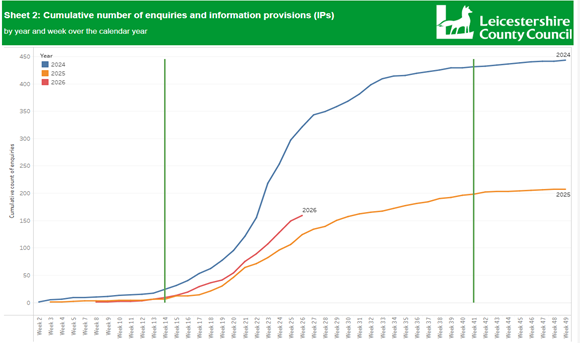
more than the same time in 2025, but half the amount received in 2024. Customer enquiry levels are where we would expect them to be at this point in the season considering the weather conditions and rate of growth this year.
2. During
the period 1 December 2024 to 19 June 2026, the Council received and logged
38 initial complaints under the category of ‘grass and hedge cutting and weed
spraying’. 3. The Council has two supervisors (based
north and south) who carry out daily monitoring and supervision of our
environmental works programmes. 4. Performance is measured against delivery
of agreed programmes of work. There are separate programmes for urban grass
cutting (up to six cuts a year), rural grass cutting (three cuts a year) and
weed spraying (three treatments a year). 5. The Council supervisors will identify any
quality or underperformance issues and ensure remedial action is agreed and
completed. 6. Rural verges are cut three times a year.
The first cut of the year is visibility locations only i.e. junctions, bends
and brows of hills. The second cut is a single swathe cut of all verges, also
including cutting of visibility areas. The third cut carried out this year
will be a full width cut, i.e. hedge to hedge, which is carried out every
third year. In years one and two, the third cut is also a single swathe and
visibility cut. An additional resource is available to address any immediate
safety concerns. Urban verges are cut up to six times a year, with the
entirety of the verge cut on each occasion. 7. No changes have been made to the
programme safety related cutting schedules or standards.”
|
|
(J) |
Mrs Taylor asked the following question of the Leader
or his nominee: |
|
|
“Can the Leader confirm whether any documentation, including contracts, correspondence, or other official materials belonging to Leicestershire County Council, has been shared with Reform UK headquarters, or with any Reform UK politicians or officials who are not part of Leicestershire County Council, either in an official capacity or privately? If so, could the Leader please provide details of:
|
|
|
Mr Dan Harrison replied as follows: |
|
|
“1. The only information that has been shared
with Reform UK (RUK) headquarters or officials who are not part of
Leicestershire County Council is a quarterly request from Ben Bradley, the
Head of Local Government, for a
“dashboard report” of statistics,
including information on the Budget, performance, number of potholes filled,
number of children and adults in care,
which are supplied with the assistance of the S151 officer of the
Council, and is information already available in the public domain. The only
other information sent to RUK was an email already sent out by the Council
entitled “Better Leicestershire- Smarter Spending, Improving Lives” which
contained information across a wide range of Council activity, including the
Better Leicestershire Programme, the £131M opening of Pork Pie Way, the
Council’s biggest ever infrastructure project, £2.5M investment to tackle
potholes, the Coalville Library refurbishment and the opening of the Ashby
Banking Hub. All of which is in the public domain. 2. The information with regard to the “dashboard report” requested by RUK is disclosable and publicly available and in specific reference to the Better Leicestershire email, this was sent to RUK as an example of how the Reform-led administration in Leicestershire is leading by example, to showcase to other Reform-led and new Reform administrations how we are working and the positive impact achieved.” |
|
|
Mrs Taylor asked the following
supplementary question: |
|
|
“I thank the Leader for his statement. In answer to my question the Leader states that information was shared with Reform UK headquarters to showcase the achievements of the Reform-led administration. The Leader has confirmed that Council officer time and resources were used to compile and supply this information. Can he confirm what the cost to the taxpayer is, and what safeguards are in place to ensure that public resources are not used for party-political purposes? Furthermore, would the same level of officer support and access to bespoke performance information be made available to any other political party that requested it?” |
|
|
With the consent of the Chairman, the Chief Executive
replied as follows: |
|
|
“I will take this question because it relates to resources within the Council and officer time. To confirm, in terms of the information shared and referred to, it was already in the public domain and complied, so there was no additional officer time used, including that of the Section 151 officer, to do that. In response to your other questions, again, we wouldn’t be using additional officer time in order to support political requests and often the information required is in the public domain already and of course, the same offer would be made to all political parties in that sense.” |
|
(K) |
Mr Bools asked the following question of the Leader or
his nominee: |
|
|
“Following the announcement of the closure of Diseworth Church of England Primary School, many parents, staff and pupils in small village schools across Leicestershire are concerned that their school could be next. Can the Lead Member for Children and Family Services reassure residents that there will be no further village school closures and explain what steps the Council is taking to ensure that small schools can remain viable long into the future?” |
|
|
Mr Pugsley replied as follows: |
|
|
“I understand the concern that the governors’ decision to propose the closure of Diseworth Church of England Primary School may have caused for families, staff and pupils both at Diseworth and in other small village schools. The circumstances at the School were specific and exceptional: pupil numbers had been falling for several years, the school faced significant financial pressures, fewer than half of available places were expected to be filled in 2026/27, and by the end of May all current teaching staff had secured posts elsewhere, leaving no teaching staff for September. The immediate priority has been to support every affected child and family to secure their on-going education. A formal consultation on the governors’ decision to propose the closure of Diseworth will begin in due course. It is important to be clear that the circumstances surrounding Diseworth are unprecedented and exceptional. The Council fully recognises the vital role that rural and village schools have in their communities. It is also important to recognise that all schools must be sustainable in terms of pupil numbers, finances, staffing, buildings and the quality of education provided. The Council’s statutory duty is to ensure there are sufficient good quality school places available in the right place at the right time. We are working with maintained schools, dioceses and academy trusts to review pupil forecasts, school finances, education quality, building capacity and community need so that any issues can be identified early and support can be targeted where it is needed. The Council has also commissioned school finance experts to review and offer support to our maintained schools in managing deficit budgets, and has introduced additional guidance, training and advice to support schools to be financially sustainable.” |